
Animals
Dog
The domestic dog (Canis familiaris or Canis lupus familiaris) is a domesticated form of wolf. The dog descended from an ancient, extinct wolf, with the modern grey wolf being the dog's nearest living relative.The dog was the first species to be domesticated by hunter–gatherers over 15,000 years ago, before the development of agriculture.Their long association with humans has led dogs to be uniquely attuned to human behavior,enabling an abundant cosmopolitan distribution and the ability to thrive on a starch-rich diet that would be inadequate for other canids

Animals
Cat
The cat (Felis catus) is a domestic species of small carnivorous mammal.[1][2] It is the only domesticated species in the family Felidae and is often referred to as the domestic cat to distinguish it from the wild members of the family. A cat can either be a house cat, a farm cat or a feral cat; the latter ranges freely and avoids human contact. Domestic cats are valued by humans for companionship and their ability to hunt rodents. About 60 cat breeds are recognized by various cat registries

Animals
Snake
Snakes are elongated, limbless, carnivorous reptiles of the suborder Serpentes Like all other squamates, snakes are ectothermic, amniote vertebrates covered in overlapping scales. Many species of snakes have skulls with several more joints than their lizard ancestors, enabling them to swallow prey much larger than their heads with their highly mobile jaws. To accommodate their narrow bodies, snakes' paired organs (such as kidneys) appear one in front of the other instead of side by side, and most have only one functional lung. Some species retain a pelvic girdle with a pair of vestigial claws on either side of the cloaca. Lizards have evolved elongate bodies without limbs or with greatly reduced limbs about twenty-five times independently via convergent evolution, leading to many lineages of legless lizards.

Animals
Octopus
Octopuses inhabit various regions of the ocean, including coral reefs, pelagic waters, and the seabed; some live in the intertidal zone and others at abyssal depths. Most species grow quickly, mature early, and are short-lived. In most species, the male uses a specially adapted arm to deliver a bundle of sperm directly into the female's mantle cavity, after which he becomes senescent and dies, while the female deposits fertilised eggs in a den and cares for them until they hatch, after which she also dies. Strategies to defend themselves against predators include the expulsion of ink, the use of camouflage and threat displays, the ability to jet quickly through the water and hide, and even deceit. All octopuses are venomous, but only the blue-ringed octopuses are known to be deadly to humans.

Animals
Tiger
The tiger once ranged widely from the Eastern Anatolia Region in the west to the Amur River basin in the east, and in the south from the foothills of the Himalayas to Bali in the Sunda Islands. Since the early 20th century, tiger populations have lost at least 93% of their historic range and have been extirpated from Western and Central Asia, the islands of Java and Bali, and in large areas of Southeast and South Asia and China. Today, the tiger's range is fragmented, stretching from Siberian temperate forests to subtropical and tropical forests on the Indian subcontinent and Sumatra.

Animals
Elphant
Elephants are the largest existing land animals. Three species are currently recognised: the African bush elephant, the African forest elephant, and the Asian elephant. Elephantidae is the only surviving family of the order Proboscidea; extinct members include the mastodons. The family Elephantidae also contains several extinct groups, including the mammoths and straight-tusked elephants. African elephants have larger ears and concave backs, whereas Asian elephants have smaller ears, and convex or level backs. Distinctive features of all elephants include a long proboscis called a trunk, tusks, large ear flaps, massive legs, and tough but sensitive skin. The trunk is used for breathing, bringing food and water to the mouth, and grasping objects. Tusks, which are derived from the incisor teeth, serve both as weapons and as tools for moving objects and digging. The large ear flaps assist in maintaining a constant body temperature as well as in communication. The pillar-like legs carry their great weight.

Animals
Monkey
Simians and tarsiers emerged within haplorrhines some 60 million years ago. New World monkeys and catarrhine monkeys emerged within the simians some 35 million years ago. Old World monkeys and Hominoidea emerged within the catarrhine monkeys some 25 million years ago. Extinct basal simians such as Aegyptopithecus or Parapithecus [35-32 million years ago], eosimiidea and sometimes even the Catarrhini group are also considered monkeys by primatologists

Animals
Giant Panda
The giant panda (Ailuropoda melanoleuca; Chinese: 大熊猫; pinyin: dàxióngmāo), also known as the panda bear or simply the panda, is a bear[6] native to South Central China.[1] It is characterised by its bold black-and-white coat and rotund body. The name "giant panda" is sometimes used to distinguish it from the red panda, a neighboring musteloid. Though it belongs to the order Carnivora, the giant panda is a folivore, with bamboo shoots and leaves making up more than 99% of its diet.Giant pandas in the wild will occasionally eat other grasses, wild tubers, or even meat in the form of birds, rodents, or carrion. In captivity, they may receive honey, eggs, fish, yams, shrub leaves, oranges, or bananas along with specially prepared food

Animals
Giraffe
The giraffe (Giraffa) is an African artiodactyl mammal, the tallest living terrestrial animal and the largest ruminant. It is traditionally considered to be one species, Giraffa camelopardalis, with nine subspecies. However, the existence of up to eight extant giraffe species has been described, based upon research into the mitochondrial and nuclear DNA, as well as morphological measurements of Giraffa. Seven other species are extinct, prehistoric species known from fossils

Animals
Goat
The domestic goat or simply goat (Capra aegagrus hircus) is a subspecies of C. aegagrus domesticated from the wild goat of Southwest Asia and Eastern Europe. The goat is a member of the animal family Bovidae and the subfamily Caprinae, meaning it is closely related to the sheep. There are over 300 distinct breeds of goat.It is one of the oldest domesticated species of animal, according to archaeological evidence that its earliest domestication occurred in Iran at 10,000 calibrated calendar years ago.

Animals
Peafowl
Peafowl is a common name for three bird species in the genera Pavo and Afropavo of the family Phasianidae, the pheasants and their allies. Male peafowl are referred to as peacocks, and female peafowl are referred to as peahens, even though peafowl of either sex are often referred to colloquially as "peacocks"

Animals
Camel
A camel is an even-toed ungulate in the genus Camelus that bears distinctive fatty deposits known as "humps" on its back. Camels have long been domesticated and, as livestock, they provide food (milk and meat) and textiles (fiber and felt from hair). Camels are working animals especially suited to their desert habitat and are a vital means of transport for passengers and cargo. There are three surviving species of camel. The one-humped dromedary makes up 94% of the world's camel population, and the two-humped Bactrian camel makes up 6%. The Wild Bactrian camel is a separate species and is now critically endangered.

Animals
Koala
The koala or, inaccurately, koala bear (Phascolarctos cinereus), is an arboreal herbivorous marsupial native to Australia. It is the only extant representative of the family Phascolarctidae and its closest living relatives are the wombats, which are members of the family Vombatidae. The koala is found in coastal areas of the mainland's eastern and southern regions, inhabiting Queensland, New South Wales, Victoria, and South Australia. It is easily recognisable by its stout, tailless body and large head with round, fluffy ears and large, spoon-shaped nose. The koala has a body length of 60–85 cm (24–33 in) and weighs 4–15 kg (9–33 lb). Fur colour ranges from silver grey to chocolate brown. Koalas from the northern populations are typically smaller and lighter in colour than their counterparts further south. These populations possibly are separate subspecies, but this is disputed.

Animals
Pig
A pig is any of the animals in the genus Sus, within the even-toed ungulate family Suidae. Pigs include domestic pigs and their ancestor, the common Eurasian wild boar (Sus scrofa), along with other species. Pigs, like all suids, are native to the Eurasian and African continents, ranging from Europe to the Pacific islands. Suids other than the pig are the babirusa of Indonesia, the pygmy hog of South Asia, the warthog of Africa, and another genus of pigs from Africa. The suids are a sister clade to peccaries.
Juvenile pigs are known as piglets. Pigs are highly social and intelligent animals

Animals
Fox
Foxes are small to medium-sized, omnivorous mammals belonging to several genera of the family Canidae. They have a flattened skull, upright triangular ears, a pointed, slightly upturned snout, and a long bushy tail (or brush).
Twelve species belong to the monophyletic "true foxes" group of genus Vulpes. Approximately another 25 current or extinct species are always or sometimes called foxes; these foxes are either part of the paraphyletic group of the South American foxes, or of the outlying group, which consists of the bat-eared fox, gray fox, and island fox.

Animals
Duck
Duck is the common name for numerous species in the waterfowl family Anatidae which also includes swans and geese. Ducks are divided among several subfamilies in the family Anatidae; they do not represent a monophyletic group (the group of all descendants of a single common ancestral species) but a form taxon, since swans and geese are not considered ducks. Ducks are mostly aquatic birds, mostly smaller than the swans and geese, and may be found in both fresh water and sea water.
Ducks are sometimes confused with several types of unrelated water birds with similar forms, such as loons or divers, grebes, gallinules and coots.

Animals
Horse
The horse (Equus ferus caballus) is a domesticated odd-toed ungulate mammal. It belongs to the taxonomic family Equidae and is one of two extant subspecies of Equus ferus. The horse has evolved over the past 45 to 55 million years from a small multi-toed creature, Eohippus, into the large, single-toed animal of today. Humans began domesticating horses around 4000 BC, and their domestication is believed to have been widespread by 3000 BC. Horses in the subspecies caballus are domesticated, although some domesticated populations live in the wild as feral horses. These feral populations are not true wild horses, as this term is used to describe horses that have never been domesticated, such as the endangered Przewalski's horse, a separate subspecies, and the only remaining true wild horse. There is an extensive, specialized vocabulary used to describe equine-related concepts, covering everything from anatomy to life stages, size, colors, markings, breeds, locomotion, and behavior.

Animals
Cattle or Cow
Cattle are commonly raised as livestock for meat (beef or veal, see beef cattle), for milk (see dairy cattle), and for hides, which are used to make leather. They are used as riding animals and draft animals (oxen or bullocks, which pull carts, plows and other implements). Another product of cattle is their dung, which can be used to create manure or fuel. In some regions, such as parts of India, cattle have significant religious meaning. Cattle, mostly small breeds such as the Miniature Zebu, are also kept as pets.

Animals
Rabbit
Rabbits are small mammals in the family Leporidae (along with the hare) of the order Lagomorpha (along with the pika). Oryctolagus cuniculus includes the European rabbit species and its descendants, the world's 305 breeds of domestic rabbit. Sylvilagus includes 13 wild rabbit species, among them the seven types of cottontail. The European rabbit, which has been introduced on every continent except Antarctica, is familiar throughout the world as a wild prey animal and as a domesticated form of livestock and pet. With its widespread effect on ecologies and cultures, the rabbit (or bunny) is, in many areas of the world, a part of daily life—as food, clothing, a companion, and a source of artistic inspiration.
Animals
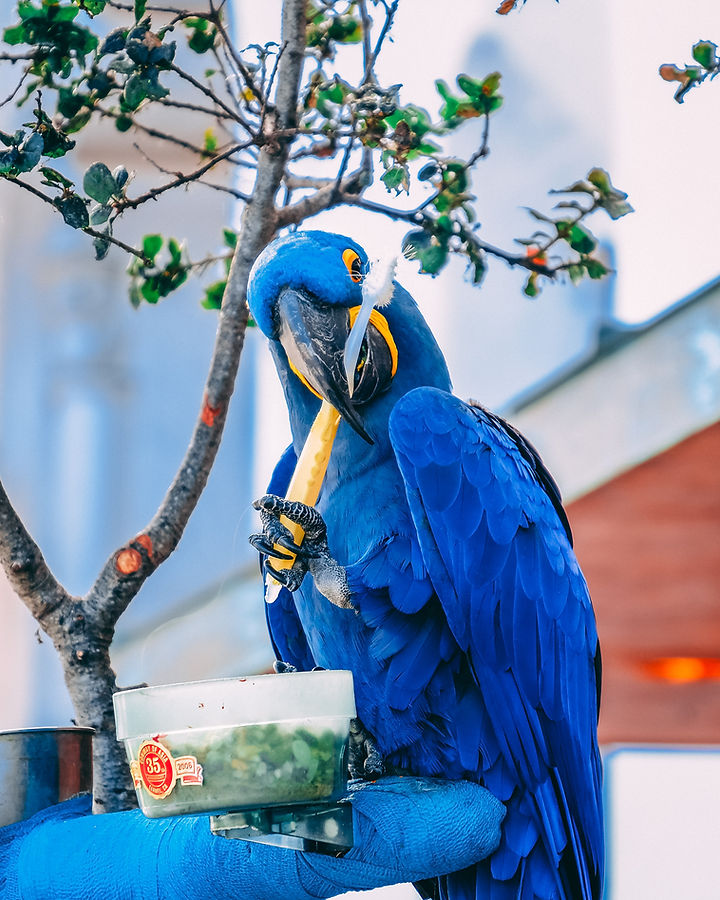
Parrot
Parrots, also known are birds of the roughly 398 species[3] in 92 genera comprising the order Psittaciformes /ˈsɪtəsɪfɔːrmiːz/, found mostly in tropical and subtropical regions. The order is subdivided into three superfamilies: the Psittacoidea ("true" parrots), the Cacatuoidea (cockatoos), and the Strigopoidea (New Zealand parrots). One-third of all parrot species are threatened by extinction, with higher aggregate extinction risk (IUCN Red List Index) than any other comparable bird group.[4] Parrots have a generally pantropical distribution with several species inhabiting temperate regions in the Southern Hemisphere, as well. The greatest diversity of parrots is in South America and Australasia.

Animals
Ostrich
Struthio is a genus of birds in the order Struthioniformes, whose members are the ostriches. It is part of the infra-class Palaeognathae, a diverse group of flightless birds also known as ratites that includes the emus, rheas, and kiwis. There are two living species of ostrich, the common ostrich and the Somali ostrich. They are large flightless birds of Africa who lay the largest eggs of any living land animal. With the ability to run at 70 km/h (43.5 mph), they are the fastest birds on land. It is farmed worldwide, particularly for its feathers as they are used as decoration and feather dusters. Its skin is also used for leather products.

Animals
Hippocampus
A seahorse (also written sea-horse and sea horse) is any of 46 species of small marine fish in the genus Hippocampus. "Hippocampus" comes from the Ancient Greek hippokampos (ἱππόκαμπος hippókampos), itself from hippos (ἵππος híppos) meaning "horse" and kampos (κάμπος kámpos) meaning "sea monster".[4][5] Having a head and neck suggestive of a horse, seahorses also feature segmented bony armour, an upright posture and a curled prehensile tail.[6] Along with the pipefishes and seadragons (Phycodurus and Phyllopteryx) they form the family Syngnathidae.

Animals
Dolphin
Dolphins range in size from the relatively small 1.7-metre-long (5 ft 7 in) long and 50-kilogram (110-pound) bodied Maui's dolphin to the 9.5 m (31 ft 2 in) and 10-tonne (11-short-ton) killer whale. Dolphins can sometimes leap about 30 feet (9.1 m). Several species of dolphins exhibit sexual dimorphism, in that the males are larger than females. They have streamlined bodies and two limbs that are modified into flippers. Though not quite as flexible as seals, some dolphins can travel at speeds 29 kilometres (18 mi) per hour for short distances.[1] Dolphins use their conical shaped teeth to capture fast-moving prey. They have well-developed hearing which is adapted for both air and water and is so well developed that some can survive even if they are blind. Some species are well adapted for diving to great depths. They have a layer of fat, or blubber, under the skin to keep warm in the cold water.